
Standing majestically on its Belfast hilltop, the Stormont building represents one of Northern Ireland’s most significant political and architectural landmarks. For over 90 years, these parliament buildings have served as the seat of devolved government, witnessing decades of political change and continuing to play a crucial role in Northern Ireland’s democratic processes.
The iconic white stone facade of the Stormont building Belfast has become synonymous with Northern Ireland politics, housing the legislative assembly and government departments that shape policy for the region’s 1.9 million residents. From its grand opening in 1932 to its current role as home to the Northern Ireland Assembly, this remarkable building combines architectural excellence with political significance.
Overview of Parliament Buildings
The Parliament Buildings at Stormont officially serve as the seat of the Northern Ireland Assembly and the Northern Ireland Executive. Located on the expansive Stormont Estate in east Belfast, these buildings represent the center of devolved government in Northern Ireland, where elected representatives from across the region gather to debate legislation and make decisions affecting all communities.
The Stormont building Belfast complex encompasses much more than the main Parliament Buildings. The 224-acre estate includes the iconic main building, Stormont House, Stormont Castle, and various administrative offices that support the functions of government. This site has served as the political heart of Northern Ireland since the establishment of the devolved parliament in 1920, following the Government of Ireland Act.
The location itself holds strategic importance, positioned prominently in Belfast to symbolize the territorial presence of the Northern Ireland government. The estate’s elevated position offers commanding views across County Down and Belfast Lough, reinforcing the building’s status as a symbol of authority and governance.
Access to the Parliament Buildings is carefully managed for security reasons, though the site remains an important destination for both political business and public education. The building serves not only as a working parliament but also as a venue for ceremonial events, state visits, and public engagement activities that connect the government with the people it serves.
Architecture and Design
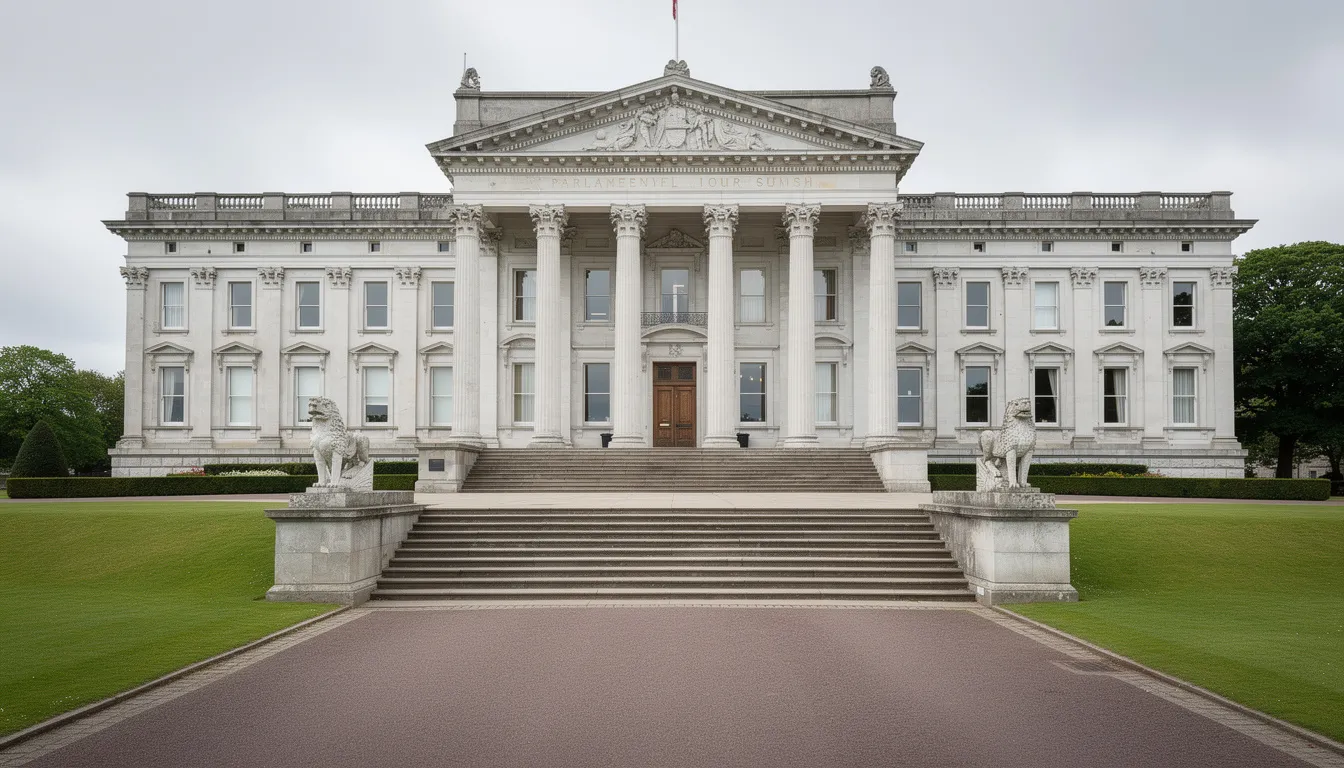
The Parliament Buildings showcase a stunning example of neoclassical architecture that reflects the grandeur and authority associated with government institutions of the early 20th century. Arnold Thornely, the Liverpool architect selected to design these buildings, created a structure that perfectly balances classical tradition with modern functionality.
Construction of the Parliament Buildings began in 1928 and took four years to complete, finally opening on November 16, 1932. The Prince of Wales, Edward Windsor (later King Edward VIII), presided over the official opening ceremony, marking the culmination of over a decade of planning and construction work. The total construction cost approached £1.7 million, making it one of the most expensive public buildings of its era.
The building’s most striking feature is its 365-foot-wide main facade, with each foot symbolically representing one day of the year. This remarkable attention to symbolic detail extends throughout the structure, including the six imposing pillars at the entrance, each representing one of Northern Ireland’s six counties. The building rises to 92 feet in height and is constructed from English Portland stone mounted on a granite base quarried from the Mourne Mountains in County Down.
The facade rises from a rusticated base that creates an impression of solidity and permanence. Four ranks of 27 windows provide natural light to the interior while maintaining the building’s classical proportions. The central design features a prominent portico and pediment, with the pediment decorated with sculpture that has been interpreted as either Northern Ireland presenting the flame of loyalty to Britain or Britain passing the flame of liberty to Northern Ireland.
A central dome crowns the building, drawing inspiration from Belfast City Hall’s dome, which was completed in 1906. This architectural choice created a visual connection between the city’s civic center and the new seat of regional government. The building contains six floors, providing ample space for the various governmental functions housed within.
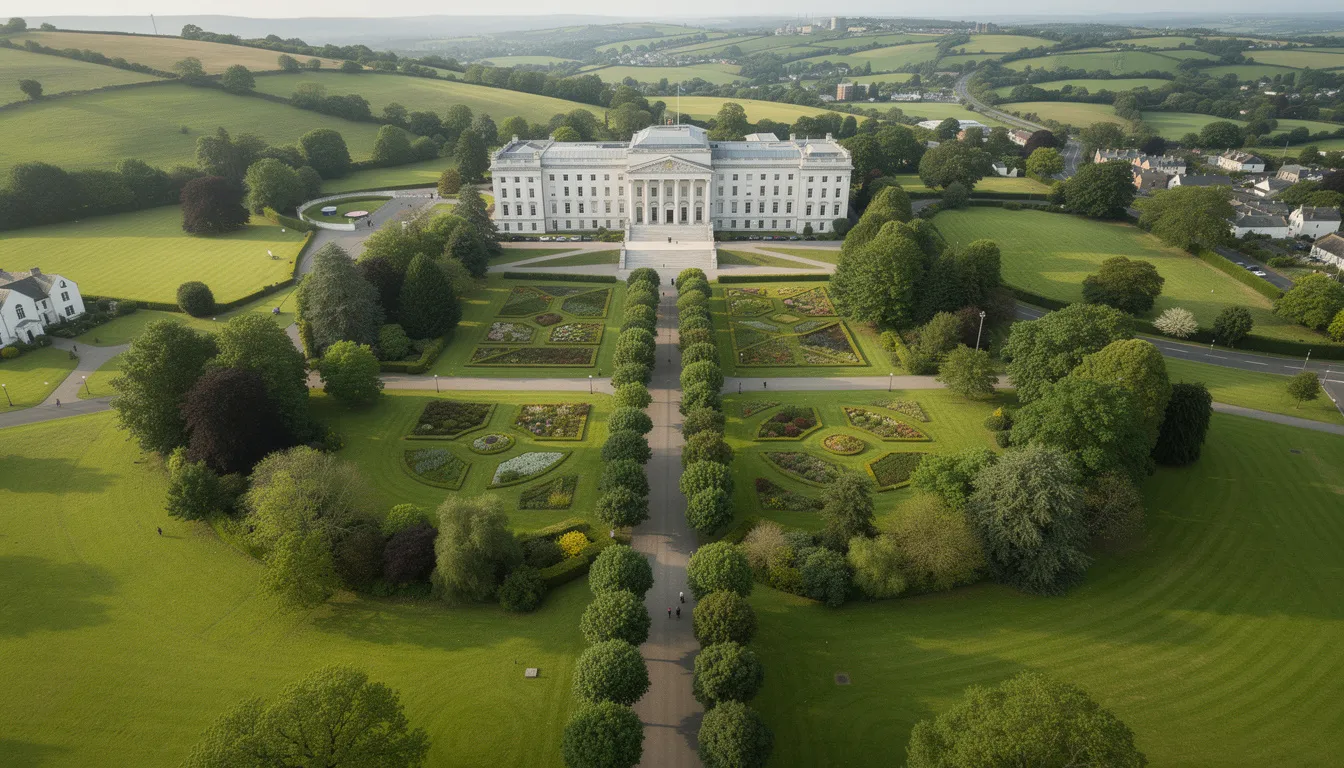
The grounds surrounding the Parliament Buildings underwent significant transformation during construction. Under the direction of W. J. Bean, former curator of Kew Gardens, and horticulturist H. A. Moore, a processional avenue nearly a mile long was constructed in direct alignment with the central portico. This avenue, which cost £57,000 to build, creates a dramatic approach to the buildings, though it terminates at the foot of a massive flight of 60 steps rather than leading directly to the main entrance.
Political Functions and Government Departments
The Northern Ireland Assembly operates from the Parliament Buildings as the devolved legislature for Northern Ireland, bringing together elected representatives from across the political spectrum. The legislative assembly consists of 90 Members of the Legislative Assembly (MLAs) who represent 18 constituencies throughout Northern Ireland, making crucial decisions about local governance, public services, and policy direction.
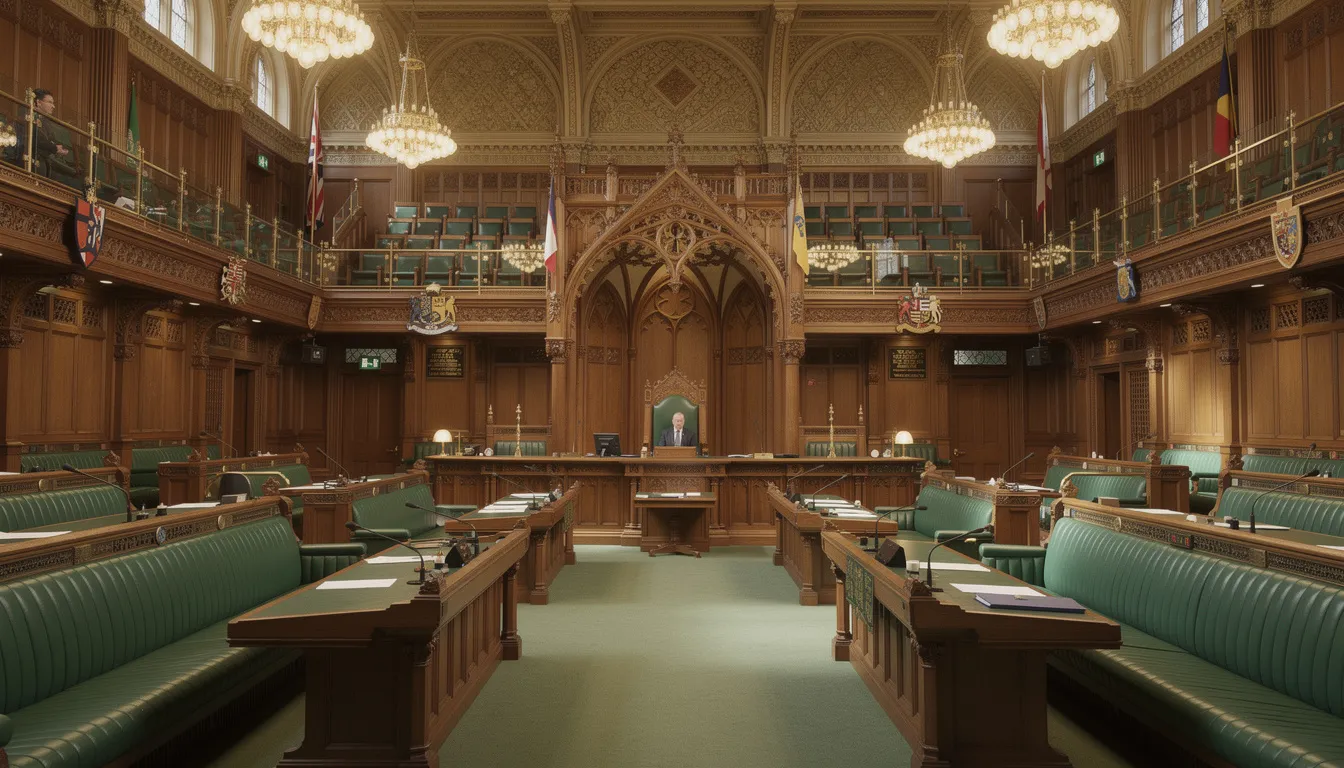
The assembly chamber serves as the focal point for democratic debate, where MLAs scrutinize government proposals, debate legislation, and hold the executive to account. The chamber’s layout follows the Westminster model, with confrontationally arranged benches facing the speaker’s chair, facilitating robust political discourse while maintaining parliamentary traditions.
Power-sharing arrangements form a central component of Northern Ireland’s political system, requiring cooperation between unionist and nationalist parties in the executive office. This unique system, established through the Good Friday Agreement, ensures that major decisions require cross-community support, promoting stability and inclusive governance.
Two Stormont departments play particularly important roles in addressing contemporary challenges. The Department for Infrastructure oversees transportation, water services, and planning matters, while the Department of Agriculture, Environment and Rural Affairs (DAERA) handles environmental protection and rural development issues. These departments, along with others housed at Stormont, work together to address the complex challenges facing Northern Ireland.
Committee rooms throughout the building provide spaces for detailed scrutiny of government policies and legislation. These committees enable MLAs to examine specific policy areas in depth, hear evidence from experts and stakeholders, and produce reports that influence government decision-making. The committee system represents a crucial aspect of democratic accountability, ensuring that all government actions face proper scrutiny.
The utility regulator and other independent bodies also maintain important relationships with Stormont departments, providing oversight and regulation across various sectors. This network of institutions ensures that government services meet appropriate standards and serve the public interest effectively.
Assembly Speakers and Leadership
Edwin Poots MLA currently serves as speaker of the Northern Ireland Assembly, following his election to this important role. Mr Poots brings considerable political experience to the position, having served as a member of the assembly for many years and previously holding ministerial responsibilities. The speaker’s role involves maintaining order during assembly proceedings, ensuring fair debate, and representing the assembly at ceremonial functions.
The Great Hall houses an important portrait tradition that honors former assembly speakers and other significant political figures. Recent additions to this collection include a portrait of Alex Maskey, the former Sinn Féin politician who served as speaker from 2020 to 2024. Mr Maskey’s unveiling ceremony celebrated his contribution to maintaining parliamentary standards during an undoubtedly challenging period for Northern Ireland politics.
Other distinguished former speakers commemorated in the portrait collection include Lord Alderdice, who served as the first presiding officer of the assembly, and Mitchel McLaughlin, who held the speaker role from 2015 to 2016. Each portrait represents not only individual achievement but also the evolution of democratic institutions in Northern Ireland.
The current speaker system reflects the assembly’s commitment to cross-community representation and shared responsibility. The speaker’s office works to ensure that all political parties and communities feel represented in the parliamentary process, maintaining the delicate balance that characterizes Northern Ireland’s unique political arrangements.
Eileen Bell, Robin Newton, and other former speakers have each contributed to establishing the traditions and procedures that guide the assembly’s work. Their portraits in the Great Hall serve as permanent reminders of the individuals who have shaped Northern Ireland’s democratic institutions during crucial periods of political development.
The portrait tradition extends beyond speakers to include other significant political figures who have shaped Northern Ireland’s history. These artistic works create a visual narrative of political progress and democratic development, inspiring current and future generations of political leaders.
Notable Spaces and Facilities
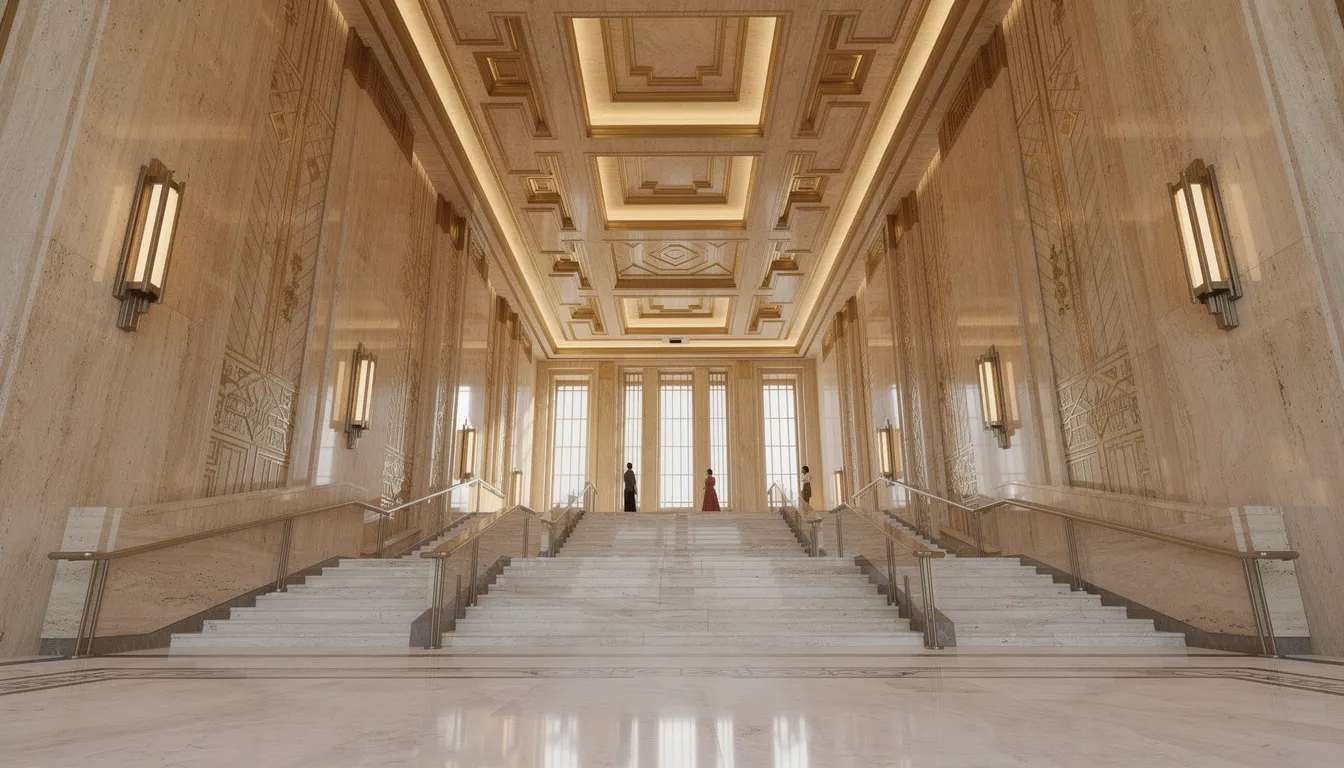
The Great Hall stands as the most magnificent interior space within the Parliament Buildings, showcasing the brilliant aesthetic of Art Deco design. The walls are covered in polished travertine marble, while the patterns of the inlaid floor and deeply coffered ceiling create a harmonious visual effect. The richly silvered ceiling contrasts beautifully with the travertine floor, creating an atmosphere of grandeur appropriate for state occasions and ceremonial events.
At the far end of the Great Hall, a grand flight of stairs leads to a large statue of James Craig, Lord Craigavon, the first prime minister of Northern Ireland, which was unveiled in 1945. This statue serves as a focal point for the hall and represents the historical continuity of Northern Ireland’s political institutions.
The assembly chamber provides the setting for democratic debate and decision-making, with modern facilities supporting both in-person and remote participation. Visitor galleries at either end of the chamber allow members of the public to observe proceedings, maintaining transparency and public engagement with the democratic process. The chamber’s paneling and design respect Arnold Thornely’s original vision while incorporating modern technology and safety features.
Committee meeting rooms throughout the building provide essential spaces for detailed policy work and stakeholder engagement. These rooms are equipped with modern audio-visual equipment, enabling committees to hear evidence from experts, conduct inquiries, and produce reports that influence government policy. The committee system represents a crucial component of democratic accountability and policy development.
Administrative offices throughout the building house the various departments and support services that enable the assembly and executive to function effectively. These spaces accommodate civil servants, political advisors, and support staff who work behind the scenes to ensure smooth government operations.
Public areas within the building are designed to welcome visitors while maintaining appropriate security measures. Guided tour facilities enable educational visits and public engagement, helping citizens understand their democratic institutions and the work of their elected representatives. These tours provide valuable insights into both the building’s architecture and its political functions.
Security arrangements balance public access with the need to protect elected representatives and government operations. Modern security systems and protocols ensure that the building remains safe while preserving its role as a symbol of democratic openness and accountability.
Recent Developments and Current Issues
Environmental protection has emerged as a significant focus for Stormont departments in recent years, particularly regarding pollution concerns affecting Belfast Lough and surrounding waters. Investigation into sewage discharge and water quality issues has prompted necessary actions from multiple government departments working to address these environmental challenges.
The past year has seen increased attention to environmental compliance and pollution prevention, with Stormont departments working to identify sources of contamination and implement necessary remediation measures. These efforts reflect growing public awareness of environmental issues and the need for government to take leadership in protecting natural resources.
Recent portrait unveiling ceremonies have celebrated the contributions of former political leaders to Northern Ireland’s democratic development. Alex Maskey’s portrait ceremony attracted attendance from across the political spectrum, demonstrating the respect accorded to those who have served in senior parliamentary roles. Such events help maintain the traditions that bind Northern Ireland’s political institutions together.
The assembly has faced undoubtedly challenging circumstances in recent years, including periods of suspension and restoration of power-sharing arrangements. These experiences have tested the resilience of Northern Ireland’s political institutions and highlighted the importance of maintaining dialogue and cooperation across traditional divisions.
Health and education remain priority areas for government attention, with ongoing efforts to address service delivery challenges and improve outcomes for all communities. Stormont departments continue to work on infrastructure improvements, housing policy, and economic development initiatives that support long-term prosperity.
Public engagement initiatives have expanded to ensure that citizens can participate meaningfully in democratic processes. These efforts include enhanced committee work, public consultation processes, and educational programs that help people understand how government decisions affect their daily lives.
Looking toward the future, planned retirement of senior political figures and the need to attract new generations of political leaders present both challenges and opportunities for Northern Ireland’s democratic institutions. The assembly continues to evolve while maintaining its essential role as the voice of all communities in Northern Ireland.
Visiting Parliament Buildings
Public tours of the Parliament Buildings provide an excellent opportunity for visitors to explore both the architectural splendor and political significance of this important site. Educational visits are available for schools and community groups, offering structured programs that help young people understand democratic processes and civic engagement.
Booking procedures for visits require advance planning due to security requirements and high demand for tours. Visitors should contact the assembly’s education service well in advance, particularly for group visits or educational programs. Individual tours may be available on scheduled dates throughout the year, subject to parliamentary business and security considerations.
Opening hours for public tours are typically restricted to specific days and times when the assembly is not in session. Summer months often provide the best opportunities for extended tour schedules, though special arrangements may be available during other periods. Visitors should check the official assembly website for current schedules and any temporary restrictions.
Accessibility information is available for visitors with mobility requirements or other special needs. The building includes accessible entrances, lifts, and facilities to ensure that all members of the public can participate in tours and events. Staff are available to provide assistance and ensure that everyone can enjoy their visit to these historic buildings.
Parking facilities are available on the estate, though spaces may be limited during busy periods or when special events are taking place. Public transport links connect the Stormont Estate to central Belfast, providing convenient access for visitors arriving by bus or taxi. The site’s location makes it easily accessible from most parts of belfast and the wider region.
Special events and public ceremonies held at Stormont include portrait unveiling ceremonies, commemoration events, and occasional state visits. These events provide unique opportunities for public engagement with political institutions, though attendance is typically by invitation or through special application processes.
The processional avenue and formal gardens surrounding the Parliament Buildings offer additional opportunities for visitors to appreciate the site’s architectural and landscape significance. These outdoor spaces provide context for understanding the building’s role as both a working parliament and a symbol of democratic authority in Northern Ireland.
Transportation options include bus routes serving the estate, taxi services, and private vehicle access subject to security arrangements. Visitors planning their journey should allow extra time for security procedures and should bring appropriate identification as required for entry to the estate.
Related topics for visitors might include exploring other significant political and cultural sites in Belfast, such as Belfast City Hall, the Ulster Museum, or historical sites connected to Northern Ireland’s political development. These connections help visitors understand the broader context of Northern Ireland’s political and cultural heritage.
The November 2025 centenary celebrations of the estate’s acquisition by the government will likely provide special opportunities for public engagement and historical reflection. These commemorative events will highlight the building’s role in Northern Ireland’s political development and its ongoing significance for democratic governance.
King Charles has visited Stormont on several occasions, reflecting the constitutional relationship between Northern Ireland and the wider United Kingdom. These royal visits underscore the building’s importance as a symbol of democratic institutions and its role in the broader constitutional framework.
The Parliament Buildings continue to evolve in their role as the center of devolved government in Northern Ireland. From their opening in 1932 to their current function as home to the Northern Ireland Assembly, these buildings have witnessed dramatic political changes while maintaining their essential purpose as the seat of democratic governance. Their architectural magnificence, combined with their ongoing political significance, ensures that the Stormont building Belfast will remain a crucial landmark for generations to come.
Whether you’re interested in architecture, politics, or Northern Ireland’s complex history, visiting the Parliament Buildings offers unique insights into the institutions that shape life in this part of ireland. The building stands as a testament to democratic values and the ongoing effort to build a peaceful, prosperous future for all communities in Northern Ireland.